


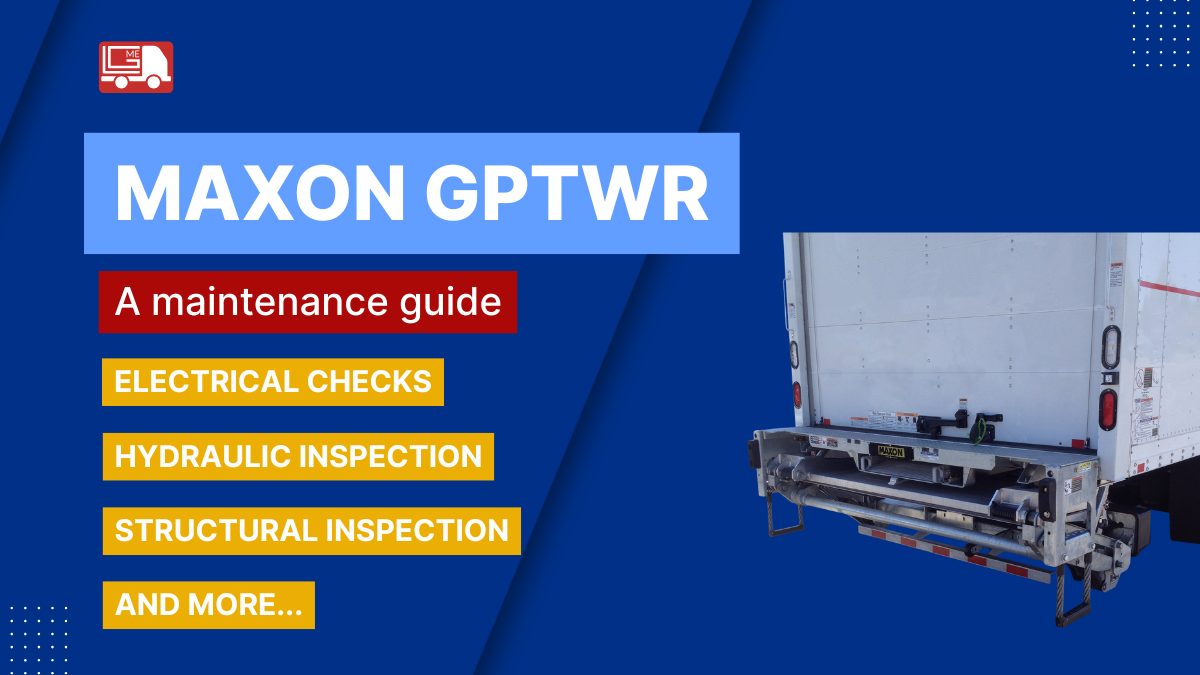
Daily inspection is one of the simplest ways to catch unsafe or worn conditions before a Maxon GPTWR is put into service. For operators, these checks are meant to confirm the liftgate is safe to use that day, not to diagnose faults or perform repairs (Maxon-GPTWR-Operation-Manual-rev-C-2025.pdf, p. 8).
This guide outlines the manufacturer’s recommended daily operational checks and related preventive inspection points.
- Documentation Resources from Maxon
- Introduction to Daily Liftgate Inspections
- Pre-Inspection Setup
- Electrical System Checks
- Hydraulic System Inspection
- Structural Component Inspection
- Platform and Load Surface Condition
- Decals and Safety Labels
- Operational Test Cycle
- Platform Level Check
- When Not to Operate the Liftgate
- Conclusion
Documentation Resources from Maxon
Information in this article is sourced from Maxon GPTWR manuals and technical guides. Always refer to your specific liftgate’s manuals for complete procedures and serial number, model, and year-specific details.
Reference PDFs used:
Introduction to Daily Liftgate Inspections
Maxon’s operation manual specifically calls for recommended daily operation checks before using the liftgate (Maxon-GPTWR-Operation-Manual-rev-C-2025.pdf, p. 8). These checks help the operator identify visible damage, leakage, missing hardware, unsafe platform conditions, or movement problems before a load is handled.
The goal is not to troubleshoot the cause of a problem. The goal is to determine whether the liftgate is in a safe condition to operate. If the inspection shows that service or repair is needed, Maxon instructs the operator not to operate the liftgate until a qualified mechanic services or repairs it (Maxon-GPTWR-Operation-Manual-rev-C-2025.pdf, p. 8).
Pre-Inspection Setup
Before checking the liftgate, Maxon says to park the vehicle on flat ground and set the parking brake (Maxon-GPTWR-Operation-Manual-rev-C-2025.pdf, p. 8). The maintenance manual also repeats that the vehicle should be on level ground while maintenance checks are being performed (Maxon-GPTWR-Maintenance-Manual-rev-F-2025.pdf, pp. 11-12).
The liftgate must be on level ground to perform accurate inspection checks. It is also the baseline for the later platform-level check.
Pre-inspection checklist
- Park the vehicle on flat, level ground (Maxon-GPTWR-Operation-Manual-rev-C-2025.pdf, p. 8)
- Set the parking brake (Maxon-GPTWR-Operation-Manual-rev-C-2025.pdf, p. 8)
- Do not proceed with the operation if the inspection reveals a condition needing service or repair (Maxon-GPTWR-Operation-Manual-rev-C-2025.pdf, p. 8)
- Never operate the liftgate if parts are loose or missing (Maxon-GPTWR-Maintenance-Manual-rev-F-2025.pdf, p. 11)
Electrical System Checks
The operation manual starts the daily checks with battery and control-related items. Operators are told to make sure the battery is fully charged and that the battery terminal connections are clean and tight (Maxon-GPTWR-Operation-Manual-rev-C-2025.pdf, p. 8). If the liftgate is equipped with a cab cutoff switch, that switch should also be ON before operation (Maxon-GPTWR-Operation-Manual-rev-C-2025.pdf, p. 8).
The maintenance manual adds related preventive inspection points by telling users to check electrical wiring for chafing and to make sure wiring connections are tight and free of corrosion. It also states that dielectric grease should be used to protect electrical connections (Maxon-GPTWR-Maintenance-Manual-rev-F-2025.pdf, pp. 11-12).
Electrical inspection checklist
- Battery fully charged
- Battery terminals clean and tight
- Cab cutoff switch ON, if equipped
- Wiring not chafed
- Connections tight and free of corrosion (Maxon-GPTWR-Operation-Manual-rev-C-2025.pdf, p. 8; Maxon-GPTWR-Maintenance-Manual-rev-F-2025.pdf, pp. 11-12)
These are simple checks, but they are important because poor electrical conditions can affect the liftgate’s ability to run through a normal cycle.
Hydraulic System Inspection
The next group of checks focuses on the pump box, cylinders, hoses, and signs of leakage. Maxon instructs the operator to visually check that the pump cover is bolted on securely and undamaged, and to look for hydraulic fluid leaking from the pump box (Maxon-GPTWR-Operation-Manual-rev-C-2025.pdf, p. 8).
Operators are also told to check the hydraulic cylinders for leaking seals and hose connections. From there, the hoses should be followed from the cylinders to the pump box to make sure all hoses are connected at both ends and show no cracks, chafing, or fluid leaks (Maxon-GPTWR-Operation-Manual-rev-C-2025.pdf, p. 8).
The maintenance manual reinforces this by directing users to check all hoses and fittings for chafing and fluid leaks and to tighten loose fittings or replace parts as required (Maxon-GPTWR-Maintenance-Manual-rev-F-2025.pdf, pp. 11-12).
Hydraulic inspection checklist
- Pump cover is secure and undamaged
- No hydraulic fluid is leaking from the pump box
- Cylinder seals are not leaking
- Hose connections sound
- Hoses connected at both ends
- No hose cracks
- No hose chafing
- No visible hydraulic leaks (Maxon-GPTWR-Operation-Manual-rev-C-2025.pdf, p. 8; Maxon-GPTWR-Maintenance-Manual-rev-F-2025.pdf, pp. 11-12)
Structural Component Inspection
Maxon’s daily checklist specifically calls for inspection of the main frame, lift arms, parallel arms, and platform openers. These parts should be checked for cracks and bends. The operator should also make sure the rollers on the platform openers roll freely, and that all bolts and pins are in place and undamaged (Maxon-GPTWR-Operation-Manual-rev-C-2025.pdf, p. 8).
The maintenance manual expands on fastener inspection by instructing users to check that all bolts, nuts, and roll pins are in place, and to make sure roll pins protrude evenly from both sides of the hinge pin collar (Maxon-GPTWR-Maintenance-Manual-rev-F-2025.pdf, pp. 11-12). It also directs users to visually check the platform hinge pins for excessive wear and broken welds during the periodic maintenance schedule (Maxon-GPTWR-Maintenance-Manual-rev-F-2025.pdf, p. 11).
Structural inspection checklist
- Main frame free of cracks and bends
- Lift arms free of cracks and bends
- Parallel arms free of cracks and bends
- Platform openers free of cracks and bends
- Opener rollers roll freely
- Bolts and pins are in place and undamaged
- No missing hardware (Maxon-GPTWR-Operation-Manual-rev-C-2025.pdf, p. 8; Maxon-GPTWR-Maintenance-Manual-rev-F-2025.pdf, pp. 11-12)
Have a question? We'd love to hear from you.
No liftgate serial number? Click here for a visual guide to locate it, then contact us.
Platform and Load Surface Condition
The operation manual separates structural checks from platform surface checks. It instructs the operator to check the platform and flipover for cracks, holes, and bends on the load-carrying surface and side plates. It also says to make sure torsion bars, coil springs, and fasteners are in place and undamaged (Maxon-GPTWR-Operation-Manual-rev-C-2025.pdf, p. 9).
Maxon also directs the operator to make sure the platform and flipover load-carrying surfaces are clean, with no oil, debris, or corrosion (Maxon-GPTWR-Operation-Manual-rev-C-2025.pdf, p. 9). For the extension plate, the daily checks require a visual inspection for cracks and bends, confirmation that fasteners are in place and undamaged, and confirmation that the extension plate is clean with no oil, debris, or corrosion (Maxon-GPTWR-Operation-Manual-rev-C-2025.pdf, p. 8).
Platform condition checklist
- Platform free of cracks, holes, and bends
- Flipover free of cracks, holes, and bends
- Side plates free of damage
- Torsion bars, coil springs, and fasteners are present and undamaged
- Platform and flipover clean
- No oil, debris, or corrosion on load surfaces
- Extension plate free of cracks and bends
- Extension plate fasteners are present and undamaged
- Extension plate clean (Maxon-GPTWR-Operation-Manual-rev-C-2025.pdf, pp. 8-9)
Decals and Safety Labels
Maxon requires the operator to visually check that all decals are in place and to make sure they are legible, clean, and undamaged (Maxon-GPTWR-Operation-Manual-rev-C-2025.pdf, p. 8). The maintenance manual repeats this requirement and includes the Maxon GPTWR decal layout and plate references on pages 24 through 26 (Maxon-GPTWR-Maintenance-Manual-rev-F-2025.pdf, pp. 24-26).
This check ensures all warning and instruction decals remain visible and legible. Missing or unreadable decals mean the operator may not have the warning and instruction information Maxon intends to remain on the liftgate.
Operational Test Cycle
After the visual checks, Maxon directs the operator to use the operation instructions in the manual to run the liftgate through one cycle without a load. That means raising the platform to vehicle bed height and then lowering it to ground level (Maxon-GPTWR-Operation-Manual-rev-C-2025.pdf, p. 9).
While the liftgate is moving, the operator is told to listen for unusual noises and look for a jerking motion or uneven movement on either side of the platform (Maxon-GPTWR-Operation-Manual-rev-C-2025.pdf, p. 9). This is an inspection check for movement quality, not a troubleshooting procedure.
Platform Level Check
One of the most important daily checks is the platform level check at bed height. With the platform unfolded and raised to bed level, Maxon says the outboard edge of the platform should be level or rise to 1 inch above bed level (Maxon-GPTWR-Operation-Manual-rev-C-2025.pdf, p. 9). The maintenance manual’s platform adjustment section uses the same acceptance range, stating the outboard edge must be level or a maximum of 1 inch above bed level (Maxon-GPTWR-Maintenance-Manual-rev-F-2025.pdf, pp. 19-20).
If the outboard edge is below the level line, the operation manual says not to operate the liftgate (Maxon-GPTWR-Operation-Manual-rev-C-2025.pdf, p. 9).
When Not to Operate the Liftgate
The manuals are clear about when the operation should stop. Do not operate the liftgate if the inspection finds a need for service or repair (Maxon-GPTWR-Operation-Manual-rev-C-2025.pdf, p. 8).
Never operate it if parts are loose or missing (Maxon-GPTWR-Maintenance-Manual-rev-F-2025.pdf, p. 11).
Do not operate it if the platform level check fails and the outboard edge is below level at bed height (Maxon-GPTWR-Operation-Manual-rev-C-2025.pdf, p. 9).
Conclusion
A proper daily inspection of the Maxon GPTWR includes checking condition, connections, load surfaces, platform position, and liftgate operation. The manufacturer’s daily checks are straightforward, but they are specific and should be followed consistently before the liftgate is used (Maxon-GPTWR-Operation-Manual-rev-C-2025.pdf, pp. 8-9).
For help with liftgate parts or selecting a tuck under liftgate for sale, contact our Team at LiftGateMe at parts@liftgateme.com or by calling (774) 266-8892.
Subscribe to keep in touch
Get our content delivered directly to your inbox. We're offering powerful content to keep you lifting throughout the year. Keep in touch with us to see why we're your Single Source partner for all things liftgate.
Recent Knowledge Share
Recent Knowledge Share
Maxon GPTWR Maintenance Checklist: Daily Inspection & Preventive Checks
Daily inspection is one of the simplest ways to catch unsafe or worn conditions before a Maxon GPTWR is put into service. For operators, these checks are meant to confirm the liftgate is safe to use that day, not to diagnose faults or perform repairs

How to Operate a Maxon GPTWR Tuck Under Liftgate
Proper Maxon GPTWR operation is essential for safe and efficient loading and unloading. Following the correct sequence ensures smooth performance while minimizing risk to operators, cargo, and equipment.

Maxon GPTWR Tuck Under Liftgate Overview: Specifications and Options
The Maxon GPTWR series is a Tuk-A-Way® liftgate offered in four capacity configurations. Based on Maxon documentation, the GPTWR platform is defined by its 60" x 80" aluminum platform, walk ramp compatibility, recessed hinge design, bolt-on extension plate and steps, and standard features such as MAX GRIP®, cycle counter, and galvanized finish.

Maxon GPTLR Maintenance: Daily Inspection Checklist for a Tuck Under Liftgate
Daily inspection is a defined operator responsibility in the Maxon manuals. The Maxon GPTLR includes a structured “Recommended Daily Operation Checks” section that must be completed before operating the liftgate. These checks are not optional. They are required to confirm the liftgate is safe to cycle and free of visible damage or system failure.
Related Content

Maxon GPTLR Series Overview | Specifications & Features
The GPTLR combines high lifting capacities, large aluminum platform configurations, and level ride geometry that allows the platform to sit completely flat on the ground when lowered. This article provides a technical overview of the GPTLR models, specifications, fitment requirements, and feature configurations.
Read More

How to Safely Operate a Maxon GPTLR Tuck Under Liftgate
According to the Operation Manual, incorrect operation can result in serious personal injury, and untrained persons must not operate the liftgate. This guide walks you step-by-step through proper operator procedure using only the official Operation Manual.
Read More

How Maxon’s GPTLR Tuck-Under Delivers True Level Ride Performance
This article explains how Maxon documents that level ride behavior and identifies the structural components and load handling principles that support stable operation. This discussion focuses strictly on mechanical design and documented load placement guidance.